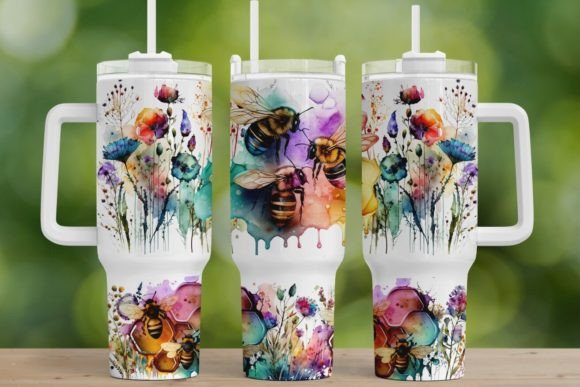
40 Oz Stanley Cup Wrap Png, Bee and Honey
A Designer’s First Glance: Sweet, Simple, and Purpose-Built
When I opened 40 Oz Stanley Cup Wrap Png,Bee and Honey, my first thought wasn’t “cute” — it was “usable.” As someone who tests hundreds of embroidery designs a year for client work and small-batch production, I appreciate when a design signals its intent clearly. This one does: a cheerful, centered bee motif wrapped around a stylized tumbler shape, with subtle honeycomb texture and soft floral accents. It’s warm but not saccharine, detailed but not fussy. The composition feels intentional for sublimation on 40oz tumblers — but as an embroidery designer, I immediately asked: *What happens when this becomes thread on fabric?*
Real-World Use: From Tote Bag to Baby Onesie
Last week, I prepped a custom order for a local boutique: six organic cotton tote bags and three linen baby onesies, all featuring nature-themed embroidery. I pulled up 40 Oz Stanley Cup Wrap Png,Bee and Honey as a starting point — not for direct digitizing (it’s a PNG, not an embroidery file), but as a visual anchor. I traced the core bee-and-honey elements into a clean, stitch-friendly layout optimized for 4–5 inch hoops. The result? A simplified yet expressive embroidered patch that kept the original’s charm without overwhelming delicate fabrics.
This design shines best when translated thoughtfully — not copied pixel-for-pixel. On a structured tote bag, the bee’s wings read beautifully in satin stitch; on a lightweight baby onesie, I reduced fill density and omitted fine interior lines to prevent stiffness. It’s not a plug-and-play machine embroidery design — it’s a strong illustration that earns its place in your graphics library because it gives you clear visual hierarchy, balanced negative space, and scalable motifs.
Where It Translates Well — And Where It Needs Care
Works naturally for:
- Embroidered patches (especially for aprons, caps, or kitchen towels)
- Sweatshirt chest embroidery — the central bee reads cleanly at 3.5–4 inches wide
- Personalized gifts like tea towels or pillow covers where warmth and approachability matter
- Boutique branding for honey shops, farmers’ markets, or eco-conscious lifestyle brands
- Holiday or baby shower embroidery — it carries gentle, celebratory energy without seasonal cliché
Use with thoughtful adaptation on:
- Stretchy or thin fabrics (like jersey or rayon): reduce stitch density and add tear-away stabilizer underneath)
- Curved surfaces (caps or mugs): simplify outer contours — the wrap format doesn’t translate directly to curved embroidery
- Dark or textured fabrics: test thread colors carefully — golden yellows and warm browns pop, but pale creams may vanish on charcoal linen
- Small hoop sizes (<3 inches): prioritize the bee’s head and wing outline; trim or omit honeycomb background details
- Frequently washed items (baby clothes, kitchen linens): avoid dense fill stitches in small areas — they can fray over time
What This Design Says About Your Finished Product
Your customers don’t see the PNG — they feel the finished product. When 40 Oz Stanley Cup Wrap Png,Bee and Honey is adapted well, it tells a quiet story: handmade care, natural charm, and attention to detail. I’ve seen Etsy sellers use versions of this motif to lift perceived value on $28 linen napkin sets — the bee stitching adds just enough personality to justify the price jump over plain fabric. It builds trust because it feels intentional, not clip-art-generic.
But misapplied? Overly dense fills on a toddler’s onesie make it stiff and uncomfortable. Tiny lettering (if added) disappears in thread. A too-literal translation of the tumbler wrap onto a flat tote bag creates awkward distortion. That’s why this isn’t just about aesthetics — it’s about respecting how embroidery behaves as a physical medium.
Practical Notes Every Embroidery Designer Should Run Through
- Test first on scrap fabric — especially if using textured or dark materials
- Check thread color contrast in both natural and artificial light — golden tones shift dramatically under fluorescent bulbs
- Review stitch density before finalizing — high-density fills work on denim, not on lightweight chambray
- Confirm hoop size compatibility — the original layout fits comfortably in a 5x7 hoop, but tighter applications need editing
- Inspect small details under magnification — those tiny honeycomb dots? They’ll vanish unless enlarged or converted to running-stitch outlines
- Mock it up in black and white — helps spot value separation issues before stitching
- Compare light/dark backgrounds — what reads softly on ivory linen may get lost on navy twill
- Choose stabilizer wisely — cutaway for knits, tear-away for stable wovens, no-show mesh for sheer fabrics
- Verify licensing — since this is a digital illustration, confirm whether your intended use (e.g., selling embroidered patches commercially) is permitted
Final Thought: A Solid Foundation, Not a Finished Answer
40 Oz Stanley Cup Wrap Png,Bee and Honey isn’t a shortcut — it’s a smart starting point. It belongs in the toolkit of embroidery designers, craft business owners, and Etsy sellers who understand that great handmade products begin with strong, adaptable illustrations. Used with intention, it supports custom apparel, personalized gifts, and small shop merchandise that feels cohesive and cared-for. Just remember: the PNG is the seed. Your skill — in digitizing, fabric choice, thread selection, and finishing — is what grows it into something people want to hold, wear, and keep.